
As we move further into 2026, Artificial Intelligence has transitioned from a “futuristic concept” to a daily operational tool. From automated scheduling to advanced data analytics, AI is helping businesses do more with less. However, for many business owners, this “AI Gold Rush” comes with a significant concern: Where is our data actually going?
At Spectrum MSP, we see technology not just as a set of tools, but as a catalyst for growth. To help you navigate this transition, here is a breakdown of how to leverage modern AI while keeping your proprietary information secure.
1. The Trap of “Public” AI
Many teams started their AI journey using free, public versions of popular Large Language Models (LLMs). The risk here is “data leakage.” When an employee pastes a sensitive client contract or a proprietary project plan into a public AI to “summarize” it, that data can potentially be used to train future iterations of the model.
The Solution: Transition your team to “Enterprise-Grade” AI environments, such as Microsoft Copilot for 365. These platforms ensure that your data stays within your “tenant”—meaning what stays in your business, stays in your business.
2. Guardrails, Not Gates
The goal of a modern IT strategy shouldn’t be to ban AI—that only leads to “Shadow IT,” where employees use unauthorized tools behind your back. Instead, businesses need clear Acceptable Use Policies (AUP).
Define what data is “AI-Ready”: Marketing copy? Yes. Private records or sensitive financial statements? Only in specific, encrypted environments.
Human-in-the-loop: Ensure that any AI-generated output (especially for client-facing work or technical configurations) is reviewed by a qualified professional.
3. The “Identity” Perimeter
In 2026, the traditional office “wall” has vanished. With hybrid work being the standard, your security is no longer about your office’s Wi-Fi—it’s about the identity of your users.
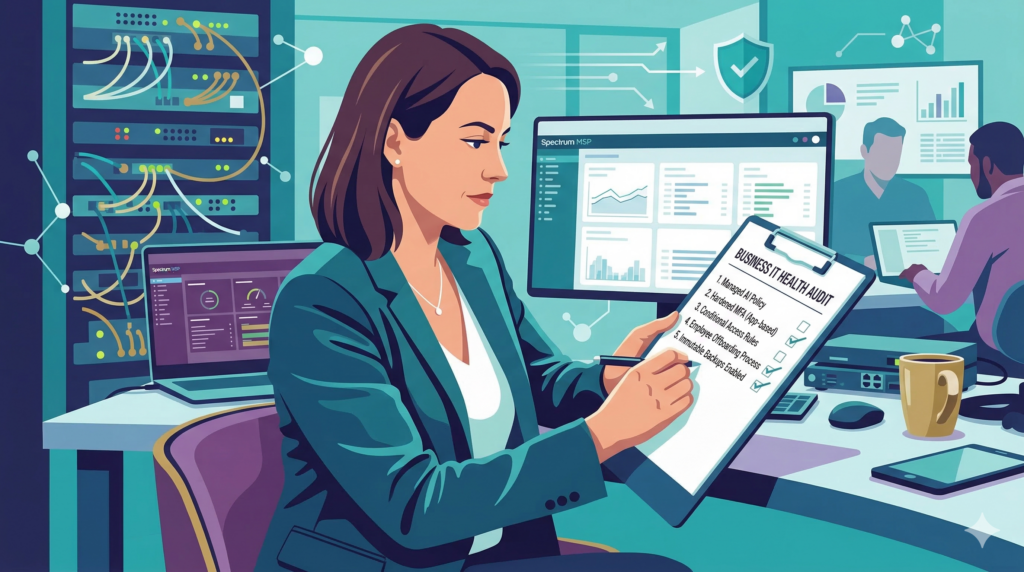
As AI makes phishing attempts more sophisticated (using deepfake audio or perfectly written “CEO fraud” emails), your first line of defense is a robust Identity and Access Management (IAM) strategy. This goes beyond simple MFA; it involves “Conditional Access,” where the system analyzes the location, device health, and time of a login attempt before granting access.
4. Moving from Reactive to Strategic
The most successful businesses have stopped viewing IT as a “repair service” and started viewing it as a “Value Center.”
When you have a strategic IT partner (often referred to as a Virtual CIO or vCIO), you aren’t just paying to fix broken laptops. You are gaining a seat at the table to discuss:
How to automate repetitive workflows to reduce burnout.
How to lower cyber insurance premiums through documented security controls.
How to scale your infrastructure before you hit a growth bottleneck.
The Bottom Line
Technology should be the engine of your business, not the emergency brake. As we look toward the remainder of 2026, the competitive edge will belong to those who adopt new tools like AI with a “Security-First” mindset.
Is your technology roadmap ready for the rest of the year? If you’re unsure whether your current setup is protecting you or holding you back, it might be time for a strategic review. Let’s ensure your technology is working as hard as you are.